
Dutch GPs also less likely to want to be clinic owners

In the Netherlands, GPs work together in cooperatives to provide after-hours care to patients in a large region. They are the gatekeepers to the ED, assessing all patients first. While in Holland I got to see them in action.
Dr. olde Hartman gave me a tour of the clinic in Nijmegen. It’s located right next to the ED and operates from 5 p.m. to 8 a.m. Monday to Friday—and all weekend! Key to efficient triage: all patients must call before being seen.
Patients who call are assessed by a practice assistant or “triagist.” They use detailed triage algorithms embedded in the electronic record to determine the visit acuity. These algorithms are based on guidelines from the Dutch college of GPs.
Based on their assessment, the triagist decides whether:
- it’s something that can be resolved on the phone
- whether the patient should follow up with their own GP the next day
- whether the patient needs to be assessed by a GP in the clinic
- whether a GP needs to assess the patient at home
- whether an ambulance needs to be called to take the patient to the ED.
More from Netherlands
There are three physician roles:
- supervising the practice assistants (answering any questions they have and also signing off on all their calls);
- seeing patients in person in the clinic;
- doing home visits.
GPs do a home visit if, for example, the call is from an elderly person who is housebound. Home visits are facilitated by a professional driver who seems to have some paramedical training.
Practice assistants are again key to the whole operation. Most are answering phone calls. One is at the front desk. One or two may be seeing patients themselves — they have training to manage issues like acute urticaria, epistaxis, traumatic wounds, and more.
All phone calls are recorded so the team can go back and review if there is an incident. There is also the option of supplementing the phone call with a quick video (patient is texted a link that automatically enables a high resolution video transmitted to the triagist’s computer). If the patient authorizes it, the triagist can see their primary care record and a note from the visit is sent to the GP.
The centre in Nijmegen serves about 400,000 people. The night I visited, there were about 10 practice assistants answering the phone and one GP supervising—all together in one room (intense!). A dashboard showed how many calls were active, how many patients were in queue and how long they were waiting. There is one “emergency line” that when triggered is answered right away.
There was one coordinator on shift who helped ensure everything was running smoothly including coordination between the home visit vehicles and the regional ambulances.
There are about about 110 of these out of hours centres in the Netherlands, all run by GP cooperatives. GPs truly are the front line 24-7 and the ED waiting rooms really are empty.
On Wednesday, Jettie Bont arranged for me to visit a call centre in Amsterdam that triages calls for the whole city (even more intense!). The set up was very similar to Nijmegen except that it coordinated intake for four after hours centres, each in a different location. The call centre was not co-located with the in-person assessment centres but did have two supervising GPs working. In Amsterdam, they had a separate triage line for those speaking English.
On Thursday, Ralf Harskamp gave me a tour of an in-person assessment centre in UMC Amsterdam. A beautiful centre that shares space with the ED. In Amsterdam, it seems they get more patients who walk-in and are triaged although this is really discouraged as the efficiency of the model really depends on patients calling by phone first.
Amsterdam
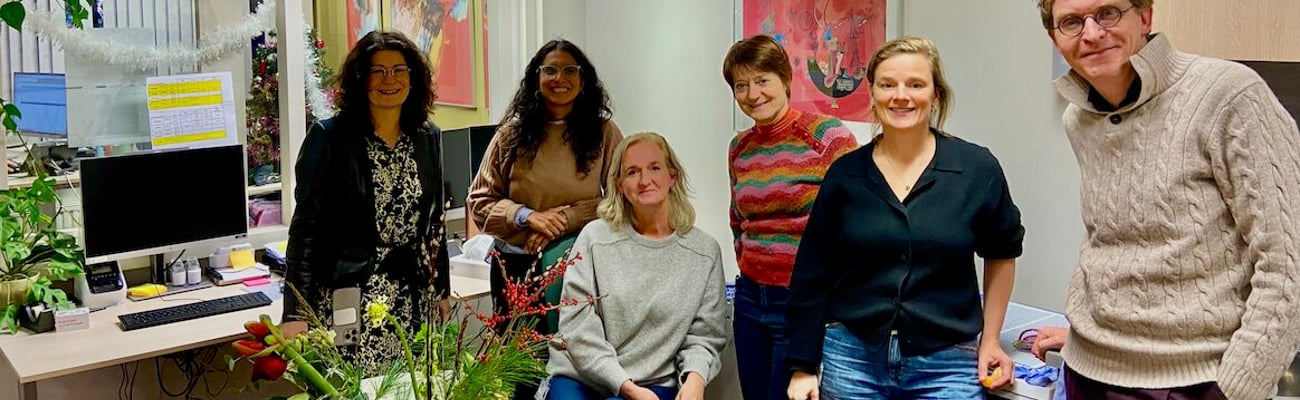
The second GP practice I visited while on my December fact gathering mission in the Netherlands was in Amsterdam. Thanks to Bont and her colleagues for allowing me to shadow them for the day.
The practice location and infrastructure was very different to the one I visited in Nijmegen—but the set up and approach to providing terrific, accessible care was similar.
They had two or three practice assistants who did telephone triage, resolved minor issues over the phone and saw patients in person for specific issues like immunizations, Pap tests and wound care. They also had one nurse to support patients with chronic conditions and one for mental health. (Funding for the nurses flows through the local GP cooperative but they are hired and situated within a practice).
Most practices in the Netherlands are GP owned but some are owned and run by non-profits. Dr. JBont’s practice was run by a non-profit, specifically the local hospital. Jettie and her GP colleagues work on salary.
Read: Read the four-part series: What a difference Denmark makes
GPs in the Netherlands can work in three ways:
- as GP owners
- as a salaried GP—hired by the practice owner to work regularly in a clinic
- as a “self-employed” GP—picking up shifts in clinics as they want
Like in Canada, there is a trend to fewer GPs wanting to be owners. However, practice ownership is still attractive to many because owners earn more and have more autonomy. Importantly, all GPs do primary care (and work after-hours!) because maintaining your GP licence requires working at least 8 hours per week in practice and 50 hours per year in the after-hours service.
There are different streams of payment to practice owners but the primary one is a mix of capitation (70%) and fee-for-service (30%). The capitation fee is based on patient age with an additional fee if they live in a deprived neighbourhood. Fees are set to enable a good income if a GP rosters about 2,100 patients (the “standard”), though there is huge variation from the 2,100 mean (roster sizes can be very high in rural areas where there are fewer GPs and the population is more stoic and perhaps less care-seeking).
Practice assistants are key to maintaining timely access even with a large roster. There are also more system efficiencies:
- centralized referral and triage: all specialists are connected to a hospital to referrals are done to specialty grouping in a hospital with the referral portal clearly summarizing the wait time for a hospital
- no sick notes: apparently doctors put their collective foot down some years ago and just refused to do these!
- integrated tools to facilitate efficient e-communication with patients: cost did not seem to be a barrier to GPs adopting these in practice. Visit fees are time-based and the same for in person or virtual.
From several discussions, it also seems that people living in the Netherlands long-term are less care-seeking than we as “foreigners” might be. This funny video gets at some of these differences.
Just like in Nijmegen, there is a wonderful team feel in the clinic. In the morning huddle, they decide whose turn it is to pick up the bread for their lunch together. Small things = big difference.
Pensions and average GP earnings
There is a pension and it appears to vary on the type of work GPs are doing (e.g. if they are an owner versus self-employed).
As for average earnings, I found it really hard to get good data. While I was in the Netherlands, someone shared this link with me but I found it hard to understand whether the figures account for practice expenses.
Essentially, most GPs and GP residents I talked to felt that compensation was generally fair. It’s lower than specialist but they have more autonomy and work fewer hours than specialists.
An interesting side note is that there is no government/medical association negotiation on fees—instead fees are set at a level that is supposed to account for actual expenses. There’s a national organization that does detailed business audits of GP practices to understand average expenses so that the rates can be set. Results of the audits and how the rates are set are all public information.
Dr. Tara Kiran is a Toronto family doctor at St. Michael’s Hospital and the University of Toronto and leads OurCare—the largest pan-Canadian initiative to engage the public about the future of primary care in Canada.