Beyond survival: This cutting edge implant aims to help men reclaim their dignity after pelvic cancers
A surgical team at Duke Health in Durham, North Carolina, has performed the first U.S. implantation of an investigational remote-controlled artificial urinary sphincter.
It may allow men who struggle with incontinence after treatment for pelvic cancers to have a more personalized and discreet way to manage bladder control.
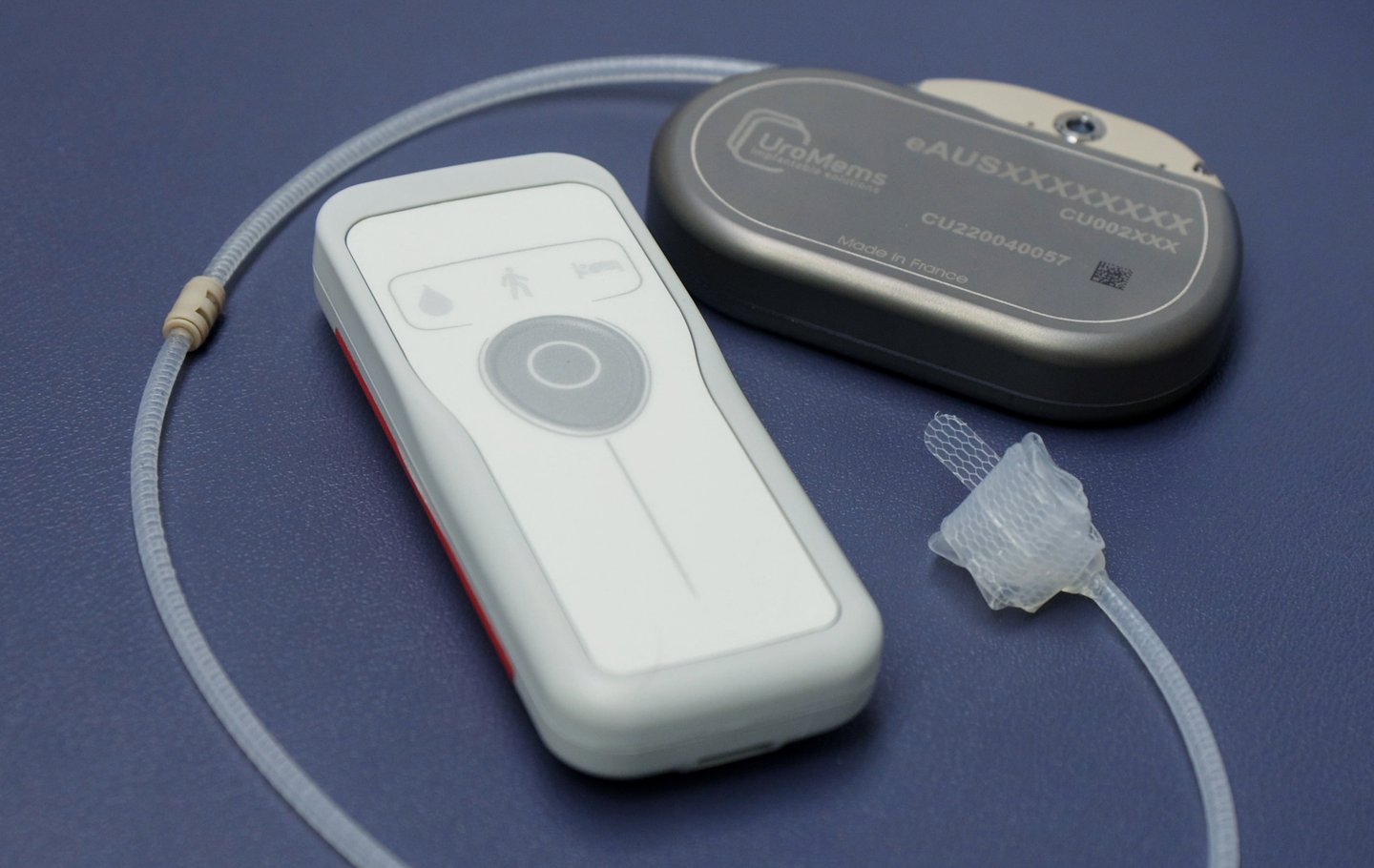
The new electronic UroActive device packs a pump, reservoir and battery into a small metal encasement, similar to a pacemaker. It is implanted in a patient’s abdomen and operated by a remote control the size of a car key fob. When a man wants to urinate, he pushes a button on the remote and that sends a signal to the device to open a cuff around the urethra, allowing urination. The device is set to a cycle which automatically closes the cuff to stop the flow and is adjustable based on the person’s activity.
Study co-principal investigator Dr. Andrew Peterson, a professor of Urology at Duke University, said cure rates are far better today for most cancers in the pelvis. Many men are living longer, healthier lives and so quality of life is a much greater concern. As a reconstructive urologist and cancer survivorship specialist, his focus has been to help men move beyond simply surviving their cancer to reclaiming their dignity.
“The most compelling potential benefit is adjustability. With conventional artificial urinary sphincters, pressure is generally fixed at the time of implantation. The UroActive system is designed to allow postoperative cuff-pressure adjustments without another operation,” Dr. Peterson told the Medical Post. “So continence can be individualized over time while seeking to avoid excessive urethral compression. That ability to tailor treatment may be especially valuable because continence needs can vary between patients and can change over time.”
Dr. Peterson said up to 20% of men develop enough incontinence after prostate cancer treatment that they require diapers or pads. The U.S. FDA approved an investigational device exemption in 2025, allowing the device to be studied in the current clinical trial. The researchers plan to follow men for up to five years to ensure its safety, durability, and a significant improvement in quality of life.
“The men most likely to benefit are those with bothersome, moderate-to-severe stress urinary incontinence caused by sphincter weakness, particularly men with persistent leakage after radical prostatectomy (RP) with or without radiation for prostate cancer. These are men who leak with activity, coughing, lifting or positional changes and who have not achieved adequate improvement with pelvic-floor therapy or other conservative measures,” said Dr. Peterson.
The current gold-standard surgical treatment is an artificial urinary sphincter that requires a man to manually squeeze a pump implanted inside the scrotum in order to urinate. For some men, especially those who are older or have limited mobility, operating the pump can be difficult. Others report feeling self-conscious using it in a public setting.
This new technology may ultimately have a role beyond prostate cancer survivorship, including men with stress incontinence after other prostate procedures or selected reconstructive and trauma-related conditions. “However, the strongest early clinical experience is in men with post-prostatectomy incontinence. Careful patient selection remains essential. Patients need adequate bladder function, a low residual urine volume, no untreated urethral obstruction or infection, and the cognitive and manual ability to operate the system,” said Dr. Peterson.
A prospective study in France with six men with stress urinary incontinence demonstrated that the UroActive device demonstrates promising feasibility, safety and functional outcomes during the 365 days postactivation.1 Men experienced substantial symptom improvement and high satisfaction. There were no surgical revisions. The study found the device to be safe and effective, reducing urinary leakage by more than 75% in 80% of the men. During the next phase of testing, up to 140 men will be enrolled at several sites in the U.S. and France.
Dr. Justin Han, a reconstructive urologist at Zucker School of Medicine at Hofstra/Northwell New Hyde Park, New York, said this device is a truly significant innovation in the treatment of male urinary incontinence, particularly for men who suffer from urinary incontinence after prostate cancer treatment. “Prostate cancer is the most common cause of cancer in men and thousands of men each year following treatment of their prostate cancer develop urinary incontinence,” he said.
Artificial urinary sphincter surgery has been the gold standard treatment for decades, he noted. However, it requires men to “cycle” their implant in order to urinate by squeezing a pump placed in their scrotum. “A pumpless artificial urinary sphincter device is a potential game-changer, as many men are reluctant to undergo the surgery due to this need to squeeze a pump every time they want to urinate. Additionally, some men do not have the dexterity and perhaps cognitive ability to use the device,” Dr. Han told the Medical Post. “By having a touch-free device controlled by a wireless fob, these barriers are minimized and may open a whole new set of patients to this surgical cure for urinary incontinence.”
Dr. Peterson also said it is too early to give a reliable timeline for when this device is routinely available in Canada. “It would depend on completion of the necessary clinical evidence, regulatory review by Health Canada, and eventual market access decisions,” he said. “Canadian participation in future clinical studies is expected and broader trials may be needed. This will all depend on the sponsor’s trial development plans and regulatory approvals.”
References:
Mozer P, Beaugerie A, Perrouin-Verbe MA, Denormandie A, Cotte J, Plassais C, et al. First-In-Human Assessment of the UroActive Electronic Artificial Urinary Sphincter for Treating Male Patients with Stress Urinary Incontinence. Journal of Urology [Internet]. 2026 Jul 1 [cited 2026 Sep 29];216(1):108–17.